Module engine with all the details of the engine cycle times
Thermal engine module with all the details of the engine cycle and times
THE THERMAL ENGINE
Definition
Functional analysis
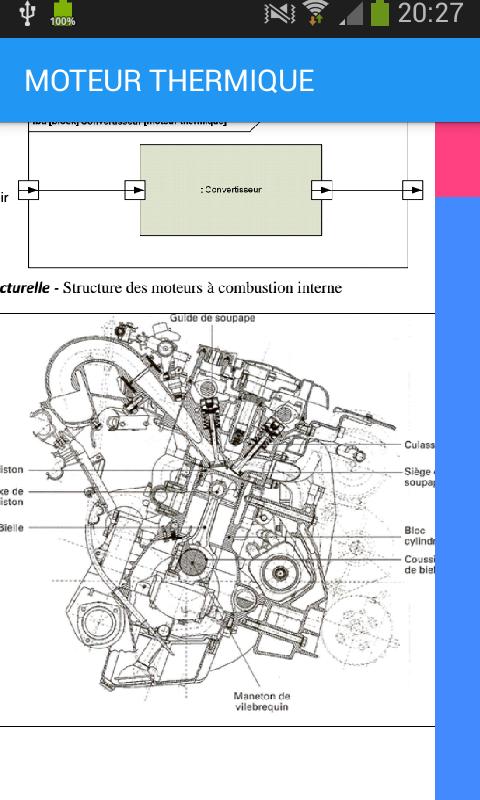
Structural analysis
Internal engine characteristics
Unit displacement
4-STROKE CYCLE OF A SMART-IGNITION ENGINE
Description of the thermodynamic cycle
1st stage: admission
2nd step: compression
3rd stage: relaxing combustion
4th step: the exhaust
CHARACTERISTICS OF AN INTERNAL COMBUSTION ENGINE
Engine torque
The average couple
The power of an engine
The specific consumption of an engine
QUANTIFICATION OF PHYSICAL PHENOMENA EMPLOYED
CLEARANCE IN INTERNAL COMBUSTION ENGINES
Theoretical air mass consumption of a 4-stroke gasoline engine
Air/fuel ratio
Theoretical thermal power released by combustion
Volumetric yield
Combustion efficiency
Thermal efficiency of the theoretical cycle
Form efficiency (real engine cycle)
Mechanical performance
engine repair technician
diesel engine
breakdown
Admission: the inertia of the gases increases with the speed of
rotation of the motor is responsible for filling
incomplete cylinder.
Compression: compression is not adiabatic. Due to the fact
of the communication of heat to the walls, the pressure
gases rise less quickly than in the adiabatic law.
Combustion: combustion of the air/fuel mixture is not
not instantaneous at TDC, hence a combustion zone
rounded on the diagram.
Expansion: the expansion of the burnt gases is not adiabatic because
the gases give up part of their heat to the walls.
Exhaust: at the end of expansion, the gas pressure is
significantly higher than atmospheric pressure.
Heat engines transform heat into mechanical work intended to balance the work
resistance of a moving vehicle.
OFPPT
AUTOMOTIVE MECHANICS
mechanical
auto mechanics
automobile mechanics
automobile
Read more